Estimating Emissions from Flower Deliveries
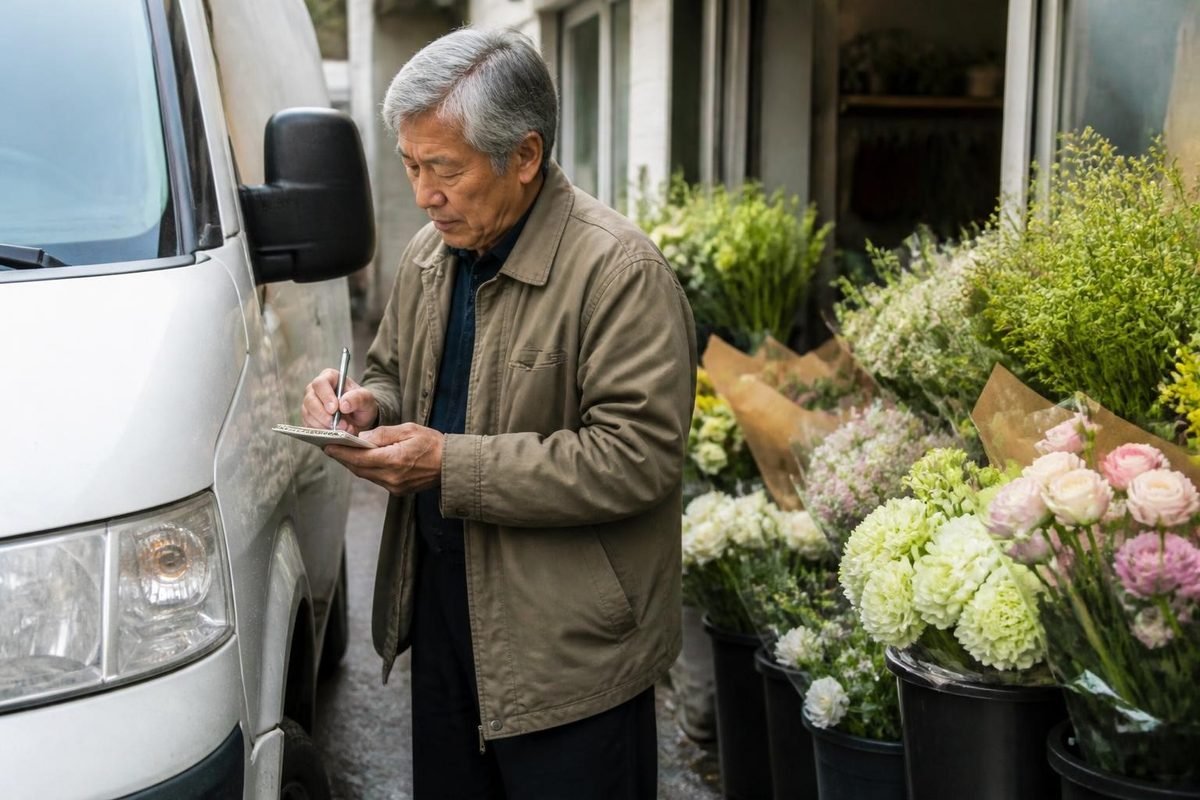
Florists can estimate delivery emissions by tracking fuel or electricity use, or by recording distance travelled, then applying a matching emissions factor. For routes carrying several orders, divide the route’s total emissions among those orders using a consistent allocation method.
Gather information for each delivery route
Set a measurement period, for example one month, and collect the records for every delivery route during that time. For each route, note the vehicle type, distance travelled, number of orders delivered and, where available, fuel or electricity consumed. Count the return journey to the shop as part of the route, including trips made back with an empty vehicle.
Fuel receipts can provide useful information, but they may cover a vehicle used for other work as well as deliveries. In that case, the receipt alone cannot show how much fuel was used for delivery trips. If delivery fuel cannot be separated from other vehicle use, distance records may be a more workable basis for an estimate. Note missing information so the limits of the calculation are clear.
For deliveries handled by an outside carrier, request its emissions figures and an explanation of the calculation. If it cannot provide these, ask for the route distance and vehicle information, or record the assumptions used to estimate emissions. Do not count the carrier’s figure and your own estimate for the same journey, as that would count the trip twice.
Work out route totals and assign them to orders
Select emissions factors from a dependable source, such as a government publication on emissions reporting. Match each factor to the information being used, whether that is fuel, electricity or vehicle activity. An emissions factor converts an amount of activity into emissions, commonly reported as carbon dioxide equivalent (CO2e).
- Select the available route measure. Use fuel consumed, in litres, if that amount is known for the route. If it is not, use the route distance with a suitable factor for each kilometre travelled.
- Apply the matching factor. For instance, a route using 5 litres of fuel, with a relevant factor of 2.5 kilograms of CO2e per litre, would have estimated emissions of 12.5 kilograms of CO2e. This calculation is an example only; the factor is not suitable for every type of fuel.
- Allocate emissions among the orders. If the route carried 10 orders, an equal split of the example total would assign 1.25 kilograms of CO2e to each order. Where orders differ greatly in size, allocation by space or weight may be more appropriate, as long as the measure is applied consistently.
- Keep the calculation record. Save the route information, the allocation approach, any assumptions, and the source and date of each emissions factor.
For electric vehicles, use electricity consumed with a suitable electricity emissions factor if consumption data is available. A distance-based factor can be used as an alternative. Check the factor’s coverage: it may describe vehicle operation alone, or also include the production and supply of energy. Use a consistent boundary when making comparisons.
Interpret estimates consistently
An emissions figure per order is an estimate, not an exact measure of the emissions caused by a particular bouquet. Splitting route emissions equally is straightforward, but it gives the same share to a small hand-tied bunch and a large event arrangement. The allocation choice affects the result, so record the method alongside the figure.
Use the same measurement boundaries and allocation method when comparing different periods. Look at route totals as well as the number of orders delivered; together, these figures can help identify opportunities to reduce emissions per order through fuller routes or shorter journeys. Keep delivery emissions distinct from emissions linked to growing, packing and storing flowers unless the calculation is intended to cover a broader footprint.
Reliable records help make estimates more useful as time passes. Begin with the information you can measure, identify what is missing, and improve those records when better data becomes available.
Keep reading: loyal customers for a flower shop